Every Polymarket trade is public. That’s the starting point for all Polymarket analytics — every wallet, every position, every dollar in or out, sitting on a blockchain anyone can read. The question isn’t whether the data exists. It’s what you do with it.
The Leaderboard: What It Shows and What It Hides
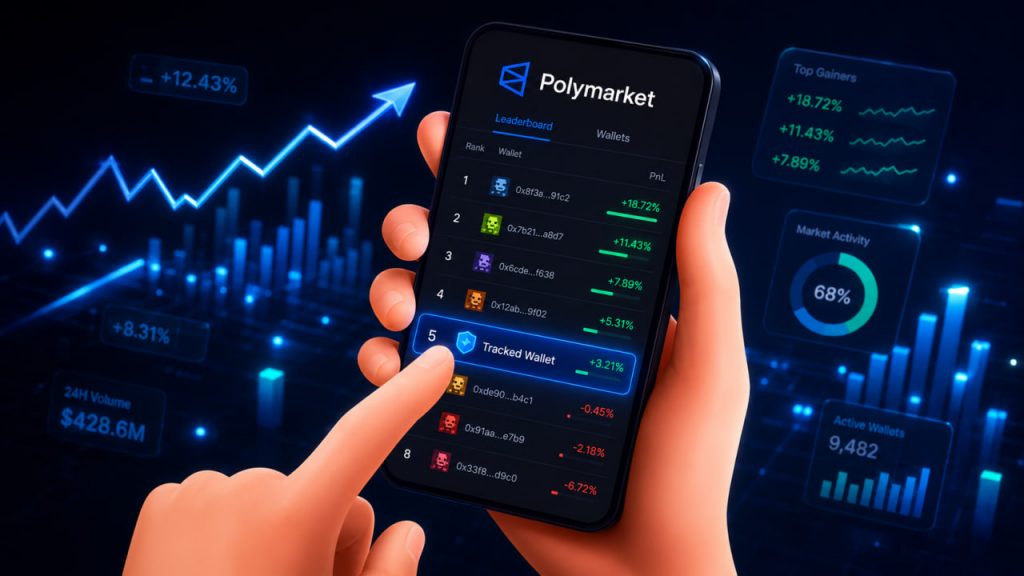
Polymarket’s leaderboard ranks wallets by total profit. It’s the first thing most people check, and it’s also the most misleading number on the platform if you take it at face value.
A wallet at the top of the leaderboard could be there because of one enormous, lucky trade. It could be a wallet with $2 million in capital taking near-zero-risk positions for tiny returns, repeated thousands of times. Both look identical on a leaderboard sorted by total profit. Neither tells you whether the strategy behind the number is something you could actually use.
What the leaderboard doesn’t show:
- Consistency. One big win versus steady, repeatable performance look the same in a single number.
- Position size. A wallet making $3 million might be doing it with trades too large for anyone but a whale to replicate.
- Win rate weighted by risk. A wallet that wins 90% of the time but loses big on the other 10% can still lose money overall.
What Wallet Tracking Actually Tells You
Tracking a specific wallet — instead of just glancing at a rank — gives you three things a leaderboard number never will:
Trading style. Does this wallet hold positions to resolution, or trade in and out before the outcome settles? Does it concentrate in one category, like sports or politics, or spread across everything?
Current conviction. What is this wallet holding right now, today — not what it made last month. Open positions tell you where a trader who’s been right before is putting money right now.
Category performance. A wallet can be sharp on political markets and mediocre on sports. Total P&L blends everything together; category breakdowns don’t.
How to Judge a Market Before You Trade It
Beyond tracking individual wallets, a few numbers are worth checking on any market before entering:
Volume. Low-volume markets have wide spreads — the gap between what you can buy at and what you can sell at. That gap eats into any edge you think you have.
Number of active traders. A market with a handful of participants moves on thin information. A market with thousands reflects a broader information base, even if it’s not always right.
Price history, not just current price. A market sitting at $0.80 today might have been at $0.50 last week. That trajectory tells you whether you’re catching a trend or stepping in after it’s already played out.
The Practical Takeaway
Polymarket analytics isn’t about finding a magic dashboard that tells you what to trade. It’s about not mistaking a leaderboard rank for a strategy you can copy, and checking the handful of numbers — volume, trader count, price trajectory — that tell you whether a market is worth entering at all.
If you want a starting point instead of building this analysis from scratch, we track and rank a filtered pool of wallets by consistency, not raw profit — the same distinction covered above, already sorted for you.
For traders who want to act on what they’re tracking, Overdog lets you copy-trade any wallet directly through Telegram — non-custodial, no KYC, set up in minutes.
Overdog · Telegram Bot
Skip the leaderboard guesswork
We already track and rank wallets by consistency, not raw profit — and every one is copy-tradeable directly through Overdog. Non-custodial, no KYC, minutes to set up.