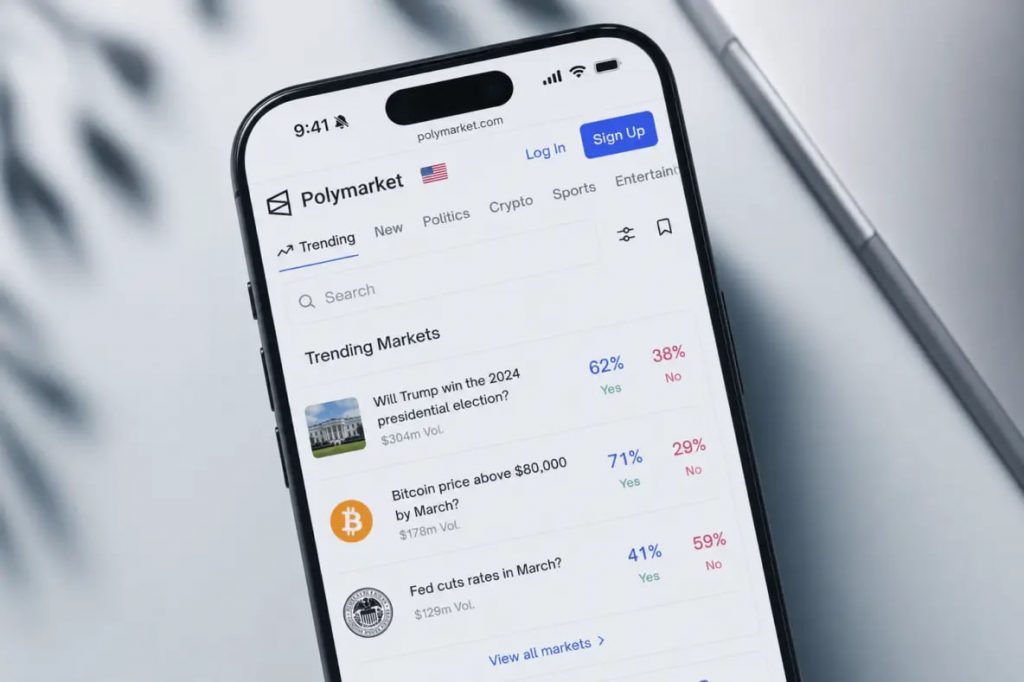
Place a limit order on Polymarket, let someone else trade against it, and you don’t pay a fee — you collect one instead. That’s the entire idea behind a polymarket maker rebate, and it reverses the normal rule that every trade on an exchange costs money.
Most traders only ever experience the other side of this. You open a market, see 62¢ bid and 64¢ ask, click buy, and pay the ask plus a fee. The person whose limit order was already sitting there before you clicked is the maker, and Polymarket routes that person a cut of the fee you just paid.
What Makes a Trade a “Maker” Trade
A maker is the side of a trade that was already resting on the order book before the match happened. Place a limit order below the current ask and wait, and you’re the maker once it fills. Click a market order, or sweep an existing limit order to get filled right away, and you’re the taker.
Makers on Polymarket pay zero trading fees on their own side of the fill. On top of that, they receive a rebate carved out of the fee the taker pays on the other side. The exchange takes a slice of taker revenue and sends it back to whoever supplied the liquidity.
How the Rebate Is Actually Calculated
The math runs off the taker fee, not the raw trade size. Polymarket first works out the matched taker fee using this formula: shares traded × fee rate × price × (1 − price). That shape pushes the fee pool toward trades near 50¢, where outcome uncertainty — and the fee itself — is largest.
Take a 100-share fill at 50¢ with a 7% taker fee. The matched fee works out to 100 × 0.07 × 0.5 × 0.5 = $1.75. The maker then receives a fixed share of that $1.75, and the size of that share depends entirely on which category the market belongs to.
Move the same 100-share, 7% fill to a price of 70¢, and the fee drops to 100 × 0.07 × 0.7 × 0.3 = $1.47 — lower even though nothing else about the trade changed. Push it further out to 90¢ and the fee shrinks to $0.63. The rebate is a percentage of that shrinking number, so a maker quoting a near-certain outcome at 90¢ is working off a much smaller fee pool than a maker quoting a genuine toss-up at 50¢.
Rebate Rates Change by Category
Not every market pays makers the same cut. According to Polymarket’s own fee documentation, Politics, Finance, Tech, Mentions, Economics, Culture, Weather, and most “Other” markets pay 25% of the matched taker fee to the maker. Crypto markets pay 20%. Sports markets pay 15%. Geopolitics markets currently pay makers nothing at all.
Run that $1.75 example through a Crypto market at 20%, and the resting limit order earns $0.35 for doing nothing but waiting on the book. Run the same trade through a Sports market at 15%, and the payout drops to $0.26. That gap is the quotable part: the identical trade, in a different category, pays a maker almost 35% less.
Polymarket pays these amounts in USDC (migrating to pUSD) roughly once a day, sent directly on Polygon from a dedicated rebate-distributor wallet, according to the platform’s own trading fees documentation.
Why Price Matters as Much as Category
Because the formula multiplies price by (1 − price), category and price interact rather than stack cleanly. A Politics market pays the best headline rate at 25%, but a Politics contract trading at 92¢ generates a tiny matched fee to begin with, so 25% of it is still a small dollar amount. A Crypto market at 20% but priced at 50¢ can out-earn it on the same trade size, simply because the fee pool it’s splitting is larger. Chasing the highest category rate without checking where the price sits is a common way to overestimate what a resting order will actually pay.
Why This Matters Beyond Bots
Serious market-makers chase this rebate at scale, because a 15-25% cut compounds fast across thousands of fills a day. That’s part of why some of Polymarket’s largest wallets behave more like trading firms than bettors. We broke down what that kind of activity actually looks like in our guide to market-making on Polymarket.
A casual trader doesn’t need bot-level volume to benefit from the same mechanic. Switching from a market order to a limit order placed a cent or two inside the spread costs a short wait, but it can flip a trade from paying a fee to collecting one. The tradeoff is that a resting order might not fill at all, especially in a thin or fast-moving market.
The rebate exists in the first place because resting liquidity carries a risk the taker doesn’t: a maker’s order can sit exposed on the book while new information moves the market, letting a better-informed taker fill against a price that’s already stale. Paying makers for supplying liquidity is how Polymarket keeps spreads tighter than they would be if every quote had to price in that risk alone.
When Chasing the Rebate Backfires
Resting on the book only pays off if the market eventually trades through your price. In a market that goes quiet before resolution, a limit order sitting a few cents off the current price can simply go unfilled, and the rebate never shows up. Markets priced near 50¢ pay the biggest rebates precisely because the outcome is still genuinely uncertain there, which is also where the price is most likely to move away from your order before it gets touched.
The rebate also assumes a trader already understands what the quoted price represents. Our guide to reading Polymarket prices as probabilities covers that groundwork before layering fee optimization on top of it.
There’s a sharper version of this risk, too. The orders most likely to finally get filled right before a market resolves are often filled by a taker who already knows — or strongly suspects — which way the news is about to break. Collecting a few cents of rebate on that fill is a poor trade if the fill itself is a sign you were about to be on the wrong side of a large move.
The Bottom Line
A maker rebate on Polymarket is compensation for the risk that a limit order sits unfilled while the market moves elsewhere. For a trader who already plans to use limit orders for price control, that rebate turns a cost center into a small, steady credit — as long as the category being traded actually pays one, the price isn’t so far from 50¢ that the fee pool is negligible, and the order gets filled before the market moves on.