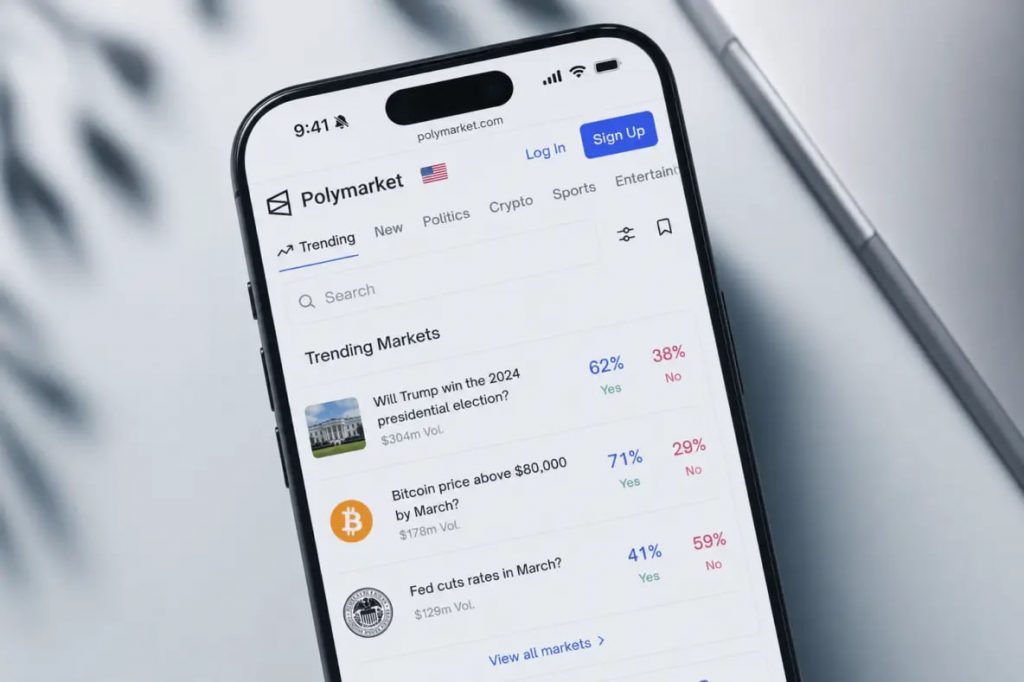
A four-cent spread on a market trading near 50 cents forces an 8% price move before a trade even breaks even. That single number explains why some Polymarket positions that look cheap on screen turn out expensive in practice. A polymarket bid-ask spread is one of the first things worth understanding, because it costs money before anyone’s opinion about the actual event matters at all.
What “Bid” and “Ask” Actually Mean
Every market on Polymarket runs on a live order book, not a single fixed price. Buyers place bids, which are the prices they’re willing to pay for a YES or NO share. Sellers place asks, which are the prices they’re willing to accept. The bid always sits below the ask, and the distance between the two is the spread.
Say the highest resting bid for YES is 62 cents and the lowest resting ask is 65 cents. The spread is 3 cents. Nobody is actually trading at 62 or 65 right now. A trade only happens when someone crosses that gap: a buyer willing to pay 65, or a seller willing to accept 62.
Polymarket’s own documentation on prices and the order book explains that the price shown on a market page is usually the midpoint between bid and ask. With a bid of 34 cents and an ask of 40 cents, the displayed price is 37 cents. A buyer still pays 40, and a seller still only receives 34. The midpoint is a reference number, not a price anyone actually trades at.
How the Spread Is Calculated
The formula is just subtraction: spread equals best ask minus best bid. What actually matters is what that gap costs as a percentage of the price, not the raw number of cents.
On a market trading near 50 cents, a 4-cent spread equals 8% of the price. On a market trading near 90 cents, that same 4-cent spread is only about 4.4%. The identical spread in cents hurts far more in the middle of the price range, which is exactly where most prediction markets sit for most of their lifespan, before a late swing toward 0 or 100 near resolution.
That math is why a 50-cent market with a wide spread can be a worse trade than a 90-cent market with a tight one, even though the 50-cent market looks like it has more room to run.
Why Spreads Widen
Spreads move with how much attention and capital a market is getting at any given moment. A few patterns show up constantly on Polymarket.
- Low-volume markets have fewer resting orders on either side, so the natural gap between bid and ask opens up.
- Markets widen right before a known catalyst, like a scheduled vote count, a game clock hitting zero, or a data release, because market makers don’t want to be the last quote standing when news lands.
- Markets widen again right after a surprise, as liquidity providers step back or reprice until the new information settles into a stable price.
Polymarket’s docs note a specific threshold tied to this behavior: once the spread opens wider than 10 cents, the platform stops showing a midpoint and switches to displaying the last traded price instead, since a midpoint between two far-apart quotes stops being a useful reference at that point.
Spread vs. Slippage: Two Separate Costs
The spread is the cost of trading right now, at the current best price on the book. Slippage is an added cost that shows up once an order is big enough to eat through more than one price level.
A small order on a liquid market usually only pays the spread once. A large order on a thin market pays the spread, then keeps paying progressively worse prices as it works deeper into the book to find enough shares. Size and liquidity matter here more than the headline spread alone.
The spread sits on top of the probability question every trader is really asking. We go deeper into that pricing logic in our guide to reading Polymarket prices as probabilities, which pairs well with spread awareness before placing a first trade on a new market.
How to Check the Spread Before Trading
The top of the order book is visible on every Polymarket market page. Three quick checks before entering a position catch most of the expensive mistakes.
First, look at the gap between the best bid and best ask in cents. Second, check how much size is actually resting at those prices, since a tight spread backed by almost no volume can vanish the instant a real order hits it. Third, compare the spread to the price move being bet on; if the expected move is smaller than the spread itself, the trade doesn’t clear its own cost before it even starts working.
Someone has to post those resting orders on both sides for the spread to stay tight in the first place. Our breakdown of market-making on Polymarket looks at who actually provides that liquidity, what the data shows about their activity, and what they earn for narrowing the gap.
The spread doesn’t go away once a trader understands it, but it stops being an invisible tax. Checking it before every entry takes about five seconds and prevents the kind of loss that has nothing to do with being wrong about the market itself.