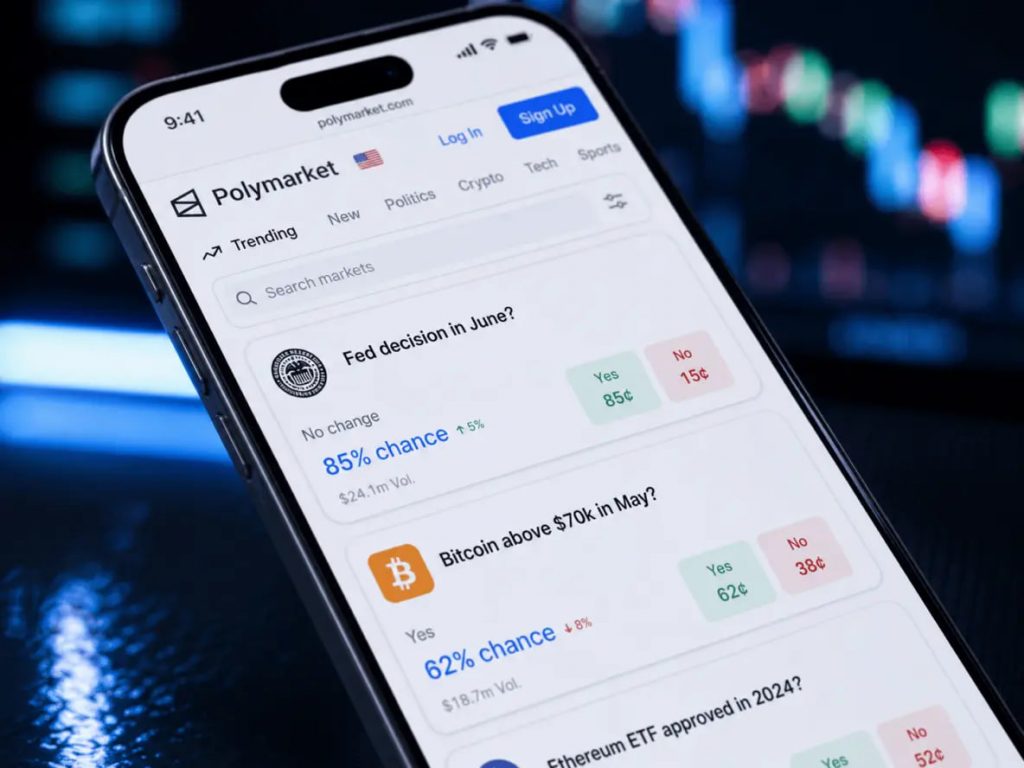
Polymarket esports odds turn matches in games like CS2, Dota 2, League of Legends, and Valorant into tradable prices. Instead of a bookmaker setting a line, traders buy and sell shares tied to a specific outcome. The price of a share reflects what the crowd of traders thinks the probability of that outcome actually is.
What a share actually represents
Every esports market on Polymarket starts as a plain question. Will Team A beat Team B? Will the series reach a deciding map? Each possible answer gets its own share, priced anywhere between $0.01 and $0.99.
Buy a “Yes” share at $0.65 and you’re paying 65 cents for a claim that pays $1 if that outcome happens. If it doesn’t, the share is worth nothing. That price doubles as an implied probability: 65 cents roughly means the market sees a 65% chance of the result. We break down the math behind this pricing in our guide to reading Polymarket prices as probabilities.
Beyond the simple win/lose bet
The basic win/lose market is a moneyline. Polymarket also runs markets tied to individual maps inside a series, the total number of maps played, handicaps where a favorite must win by a set margin, and player or team props tied to specific milestones, like a team winning the first map of a Best-of-3.
These smaller markets let traders react mid-series instead of waiting for a final result. Someone can buy a team at $0.40 before a series starts, watch that team take the opening map, then sell at $0.60 without holding until the match ends. Prices move continuously as new information arrives, not just at the final scoreboard.
Coverage spans major titles including Counter-Strike 2, Dota 2, League of Legends, Valorant, Overwatch, Rocket League, and Rainbow Six Siege. Markets open for tier-one majors, regional leagues, and qualifiers, though liquidity varies a lot between a marquee final and a lower-tier regional bracket.
Where the prices actually come from
Nobody sets these prices centrally. They move because traders buy and sell shares against each other on an order book, similar to a stock exchange. A wave of buying on one team pushes its price up; heavy selling pushes it down.
This structure means esports prices can move faster than a traditional sportsbook line, especially around roster changes, patch updates, or a surprise result on an early map. Liquidity plays a big role here. High-profile matchups at majors draw enough trading volume to keep the gap between buy and sell prices tight, while a niche qualifier can have a much wider spread between what buyers and sellers are willing to accept.
How a match actually gets settled
Resolution runs through Polymarket’s UMA Optimistic Oracle, built around a request-propose-dispute cycle. After a match ends, a proposer submits the result and posts a bond, commonly around $750 in stablecoin. A two-hour challenge window follows.
If nobody disputes the outcome, the market pays out automatically once that window closes. A dispute triggers a second proposal round, and if the disagreement still isn’t settled, UMA token holders vote on the correct outcome after a debate period that typically runs one to two days. Disputed esports resolutions are uncommon but not unheard of — ambiguous wording in a market’s rules can create exactly this kind of standoff, and we’ve tracked several cases across different market categories in our rundown of resolution disputes that shook trader confidence in 2026. The full bond structure and voting mechanism are laid out in Polymarket’s resolution documentation.
What happens when a match doesn’t go as scheduled
Esports has its share of postponed matches, forfeits, and no-shows, and Polymarket’s resolution rules account for that. If a match is postponed, it needs to be rescheduled within 14 calendar days of the original date for the market to resolve on the actual result. Miss that window, and the market resolves 50-50 regardless of whether the match is later played.
If one team wins through a forfeit, disqualification, or walkover after the match has begun, the market resolves to that team as the winner. A match that never starts at all, or ends in a tie with no tiebreaker, also resolves 50-50. These rules are published before trading opens on any given market, and they’re detailed in Polymarket’s sports resolution FAQ.
Fees and what changes hands
Esports markets use a maker-taker fee model. Placing an order that adds liquidity to the book costs nothing. Taking an existing order costs a small fee that scales with trade size, peaking near the 50-cent price point and shrinking toward the extremes of the range. A portion of that fee flows back to makers through a rebate program, an incentive to keep quoting prices on both sides of a market instead of just taking whatever is on offer.
Everything settles in USDC, a stablecoin pegged one-to-one to the US dollar, on the Polygon network. That keeps deposit and withdrawal costs low regardless of position size, and it means winnings land in a crypto wallet rather than a bank-linked betting account.
Why the odds move the way they do
Esports prices react to information a traditional bookmaker sometimes lags on: a player switching rosters mid-season, a patch note affecting a team’s strategy, or a coach’s comments before a series. Because pricing is continuous, a market can reprice within minutes of news breaking rather than waiting for a scheduled odds update.
A share price already reflects what the collective pool of traders believes about the outcome. Beating that price consistently means knowing something the rest of the market hasn’t priced in yet, or reacting to new information faster than everyone else holding a position.