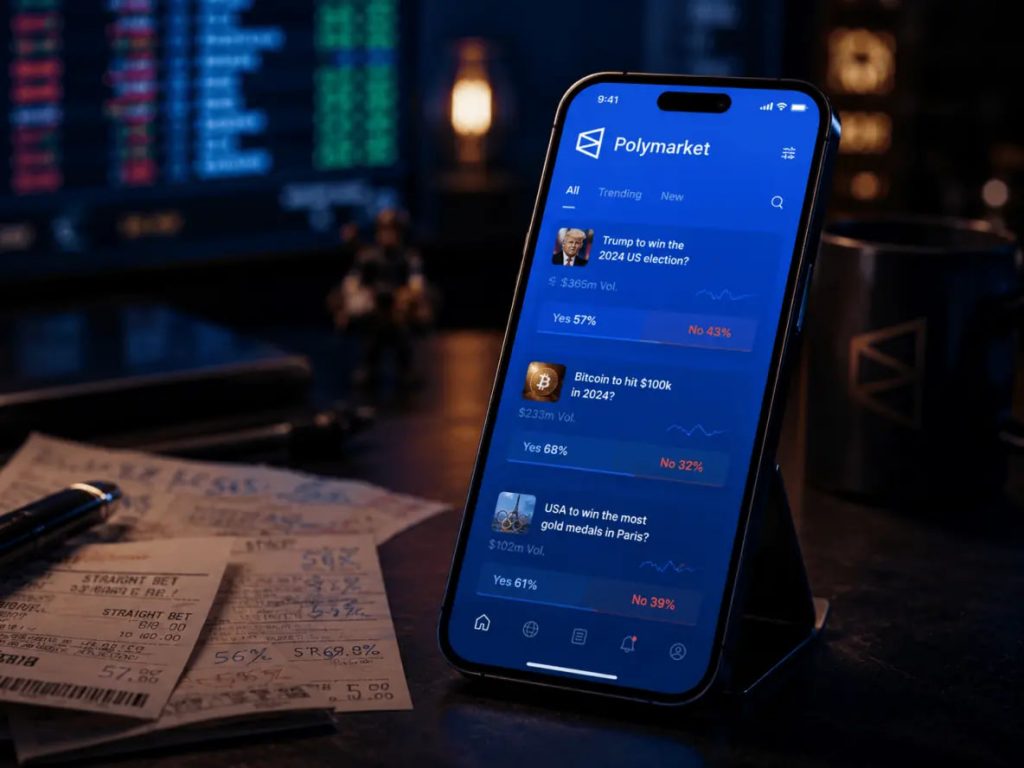
Tema ETFs put a brand-new prediction market ETF on the Cboe exchange on September 9, 2026, giving anyone with a standard brokerage account a way to own a piece of the companies behind Polymarket and Kalshi — no crypto wallet, no platform sign-up required. The fund trades under the ticker DICE and carries the full name Trading & Prediction Markets ETF, marking the first time Wall Street has packaged the prediction-market boom into a single, easily tradable stock-market product.
Timing plays a big role here. For the past twelve months, Kalshi has battled state regulators over its sports contracts while Polymarket has remained locked out of huge swaths of the globe, including US retail bettors for years. Wrapping exposure inside a stock-market fund sidesteps both headaches at once — no KYC verification, no geo-blocking, just ordinary share purchases through any brokerage.
What DICE Actually Holds
According to Tema’s own launch announcement, Kalshi and Polymarket each claim roughly 7.3% of the fund’s total assets — a weighting that hands retail investors indirect access to two companies normally reserved for venture capital backers. DICE fills out the remaining portfolio with Robinhood, Coinbase, and Circle Internet Group, all businesses that profit from the broader trading infrastructure around prediction markets. Expect to pay a 0.75% gross expense ratio, a figure that runs higher than most thematic ETFs charge but tracks closely with other funds that carry private-company stakes.
Earlier this year, a funding round pushed Kalshi’s valuation to roughly $22 billion, which means DICE’s 7.3% weighting hands ordinary buyers a small stake in that number without any accredited-investor paperwork. Polymarket sits at a near-identical weighting in the fund, even though US retail bettors still can’t access the platform directly.
Why the Fund Skips Event Contracts Entirely
Don’t expect to trade actual contracts like “will the Fed cut rates” or “who wins the midterms” through DICE — the fund sticks to equity and private-company stakes instead. Regulators at the SEC still haven’t finished reviewing event contracts, so no retail fund can legally build itself around trading them directly yet.
Anyone expecting DICE to mirror a basket of live Polymarket or Kalshi positions should recalibrate that expectation now. A political market flipping or a sports contract resolving won’t budge the share price at all — instead, DICE rises and falls with the stock values of the companies running these platforms and the infrastructure that supports them.
Why This Matters for Everyday Investors
Until DICE arrived, anyone wanting exposure to Polymarket or Kalshi faced exactly two choices: sign up and trade directly, or skip the sector altogether. Our Polymarket vs Kalshi comparison breaks down just how wide that access gap really runs — Kalshi operates as a CFTC-regulated exchange open to US residents, while Polymarket spent years locking out US retail users and only recently began rebuilding under a separate compliant entity.
DICE erases that access barrier for anyone who simply wants financial exposure to the industry’s growth rather than an active trading account. Live in a state currently fighting Kalshi over its sports contracts, or a country where Polymarket stays geo-blocked? A normal brokerage account still lets you own a slice of both companies.
The Catch: Stock Exposure Isn’t Volume Exposure
Buying shares of DICE has nothing to do with riding the platforms’ trading volume up or down — the fund’s performance follows the equity value of Kalshi, Polymarket, and its other holdings, not the dollar amount flowing through event contracts on any particular day.
That gap already showed up in the numbers. Combined Kalshi and Polymarket trading volume dropped 14.5% in August, sliding to $45.33 billion and marking the first monthly decline in a full year, right after a World Cup-fueled surge in June and July had pushed volumes to all-time highs. A drop of that size eventually weighs on platform revenue and company valuations, but it won’t move DICE’s share price one-to-one on any single day, since Robinhood, Coinbase, and Circle round out the rest of the fund.
Regulatory Overhang Still Shapes the Picture
An active rulemaking process explains why DICE sticks to equity instead of event contracts. Back in June 2026, the CFTC published a proposed rule spelling out which event contracts prediction markets can legally offer, zeroing in especially on sports contracts and anything touching elections, war, or assassinations. The Federal Register notice on prediction markets spells out exactly which categories regulators view as contrary to the public interest.
Meanwhile, a separate fight has been playing out at the state level: Connecticut, Washington, and several other states have sued Kalshi directly over its sports contracts, arguing they amount to unlicensed gambling rather than federally regulated swaps. Our coverage of Polymarket’s legal status under the CLARITY Act tracks that same clash between state gambling law and federal derivatives law, which underpins Kalshi’s business just as much. Until courts and regulators settle that question, no ETF can legally hold event contracts directly — and that’s precisely why Tema chose to build DICE around company equity instead.
What to Watch Next
Whatever stance the SEC eventually lands on for event-contract products will determine whether funds like DICE can evolve into something closer to a direct prediction-market tracker down the line. Right now, DICE lets retail investors bet on the industry’s growth as a business rather than on the outcome of any single market. Before buying in, make sure you understand that difference — your shares won’t track daily odds swings on Polymarket or Kalshi.
Step back, and the bigger story is what it means that a Wall Street ETF issuer decided this sector deserved its own fund at all — a sign of just how mainstream prediction markets have grown in under two years. Whether that momentum turns into sustained trading volume growth or another slump like August’s will ultimately decide how DICE, and any competing funds that follow it, actually perform.