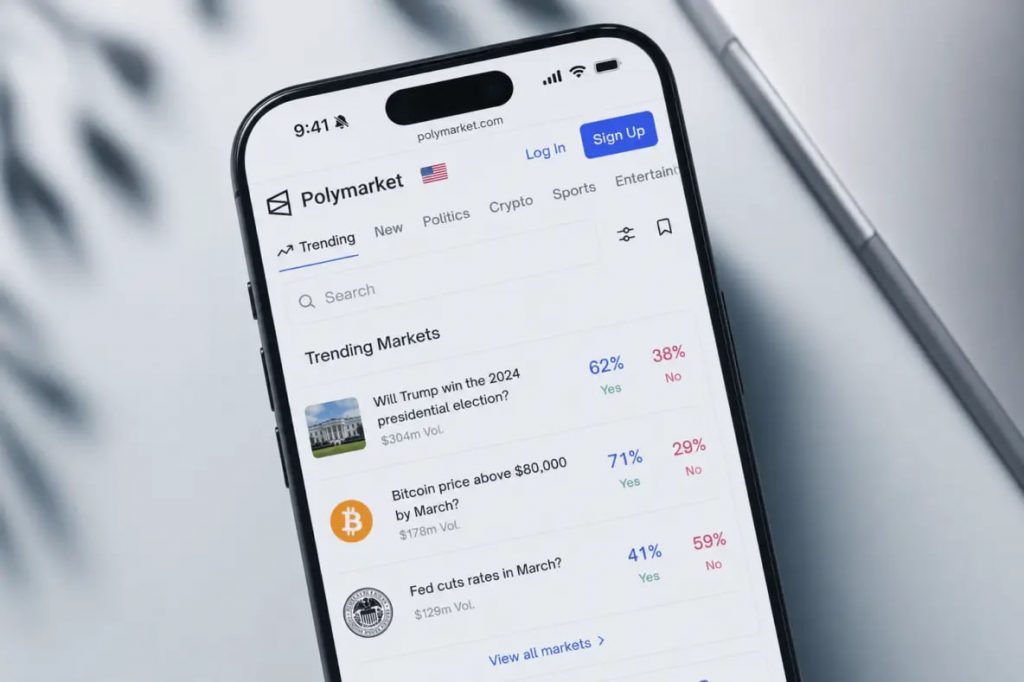
Esports bettors who also use a regular sportsbook eventually run the same comparison. Polymarket vs bookmaker odds comes down to three things: how each side prices a match, where the cost is hidden, and how fast each one reacts when a roster changes or a map gets banned. The mechanics differ enough that the same match can carry two different implied probabilities at the same moment. The comparison plays out clearest in esports, where thinner liquidity and faster-moving news exaggerate differences that stay small in a market like NFL spreads.
Two different ways to set a price
A sportsbook sets a line before it takes any bets. Traders on Polymarket set the price themselves, buying and selling shares against each other while the platform never takes a side.
A YES share trading at 58 cents means the market currently prices that outcome at roughly 58% probability. We covered how Polymarket’s esports markets translate share prices into probability in more detail, including how moneyline, map-handicap, and prop markets work across CS2, Dota 2, League of Legends, and Valorant.
A sportsbook expresses that same 58% as a moneyline of roughly -138. Both formats describe implied probability, but a sportsbook’s number carries something extra built in: the vig.
Where the cost actually sits
Vig, short for vigorish, is the margin a bookmaker bakes into both sides of a line. At standard -110/-110 pricing, the implied probabilities on both outcomes add up to about 104.8% instead of 100%. That extra 4.8% is the sportsbook’s built-in edge, present before a single round is played.
Esports lines tend to run wider than that baseline, with margins on major matches typically sitting in the 5-8% range and niche regional leagues pushing past 10%, since books price in extra uncertainty for games with thinner historical data than football or basketball.
Sharp books complicate a clean comparison. A book like Pinnacle, often cited as the sharpest line in the market, has posted median win margins closer to 4.5% on major CS2 series, tighter than the average recreational sportsbook but still built into the quoted price rather than charged separately.
Polymarket works differently. A YES and a NO share on the same market are complementary claims on one dollar, so their prices add up close to $1.00 with no margin baked into the quote. The cost instead shows up as a separate taker fee, charged only to whichever side removes liquidity from the order book. Sports markets currently carry a taker fee rate of about 5%, applied heaviest near a coin-flip price and shrinking toward zero as a price nears its extremes.
Makers, the traders whose resting limit orders get filled by someone else, pay nothing and can even earn a rebate. That split gives an active trader more control over cost than a sportsbook’s fixed line allows.
Who reprices faster when the news breaks
A sportsbook’s trading desk exists to move a line within seconds of a confirmed roster change or a map veto. Because the house is always the counterparty, it can post a fresh number instantly, even on a thin regional match few people are watching.
Polymarket only moves when a trader places an order. On a heavily traded LCK or Major final, that happens almost as fast as a sportsbook adjusts. On a smaller bracket match, the gap between the best bid and best ask can sit wider for longer, simply because fewer people are actively quoting it.
Liquidity depth changes the math too. A Valorant Champions final or an LCK final can carry six-figure volume on Polymarket with spreads of a cent or two, closing the gap with a mainstream sportsbook almost entirely. A Tier 3 bracket match might trade only a few hundred dollars deep, wide enough that the effective cost of a market order rivals a bookmaker’s vig regardless of which platform technically charges less.
That gap cuts both ways. Anyone with an opinion can post a limit order the moment a roster announcement goes out, without waiting on a risk manager to sign off on a new line, so Polymarket occasionally beats a sportsbook to a repriced match.
Settlement: a public dispute window vs a grader’s decision
A sportsbook grades a bet against its own rulebook, written and enforced by the operator. Disputes go through customer support, and the operator has the final word.
Polymarket settles through the UMA Optimistic Oracle: a proposer posts the outcome, a bond backs the proposal, and anyone can dispute it within a challenge window before it goes to a token-holder vote. That process has occasionally produced messy outcomes when a market’s rules were ambiguous going in, something detailed in a separate look at resolution disputes that shook trader confidence in 2026. A sportsbook’s grading is faster and less transparent about the process behind it. Polymarket’s is slower, but it leaves a public record of who proposed what and why.
What this actually means for bettors
The fee math favors Polymarket on most liquid esports matches. A roughly 5% taker fee that peaks near a coin-flip price beats a 5-8% vig baked into every line, and it shrinks close to zero near the edges of the price range where a heavy favorite trades.
That edge narrows on thin markets. A wide spread on an illiquid Polymarket contract can end up costing more than a sportsbook’s vig would have, and a sportsbook’s guaranteed liquidity has real value for a bettor who wants a bet placed instantly rather than wait on a matching order.
The practical move is to check both sides of a match before betting. Compare the Polymarket price against the sportsbook’s moneyline, and let the tighter number and the deeper order book decide where the bet goes. For a high-volume LCK or Major final, that check usually favors Polymarket. For a smaller bracket match, a sportsbook’s guaranteed fill can be worth paying extra for.