How does Polymarket work? Every price is a probability, set by an order book, settled by an oracle. That is the entire system in one sentence. If you already know what Polymarket is, this is how the machinery underneath actually functions — order matching, settlement, and dispute resolution — not the beginner overview.
The Order Book, Not a House Odds Model
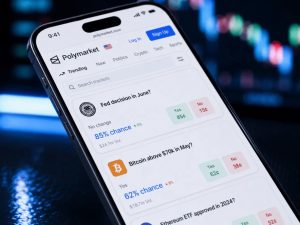
Traditional sportsbooks set their own odds and bake in a margin. Polymarket does not set prices at all. Buyers and sellers post limit orders for YES and NO shares, priced between $0.01 and $0.99, and a matching engine pairs them the same way a stock exchange order book works. The last matched price is the market’s implied probability. Nobody at Polymarket decides that a market is “70% likely” — thousands of individual orders do, continuously, as new information arrives.
This matters for accuracy. A bookmaker’s odds reflect one organization’s model plus a margin. An order-book price reflects the aggregate, real-money view of every participant currently willing to trade — which is why these markets tend to move faster and correct faster than a sportsbook line does.
How a Market Actually Settles
Markets resolve against a specific, pre-defined source: an official election result, a Federal Reserve announcement, a verifiable on-chain event. A UMA-based oracle process proposes the outcome. If nobody disputes the proposed result within a challenge window, it finalizes automatically and share payouts execute on-chain.
If someone disputes it, the question escalates to UMA token holders, who vote on the correct outcome using economic incentives designed to reward honest reporting. This is the part that differs fundamentally from a centralized platform: there is no single company that can quietly decide “the reds resolve YES.” The dispute path is public and adjudicated on-chain.
Share Settlement, With a Real Example
YES and NO shares always resolve to exactly $1.00 or $0.00 — never anything in between. If “Will the Fed cut rates in September” trades at $0.30 and you buy 500 YES shares for $150, a YES resolution pays you $500 (a $350 profit); a NO resolution pays $0 (a $150 loss). The price you pay is functionally the market’s live probability estimate at the moment you trade, which is why prices swing hard around news, not gradually.
| Mechanism | Polymarket | Traditional sportsbook |
|---|---|---|
| Who sets the price | Order book (traders) | The bookmaker |
| Settlement | On-chain, oracle-verified | Internal, manual |
| Dispute process | Public, UMA vote | Customer service, discretionary |
| Built-in margin | ~2% trading fee | 5–10% vig |
Where Liquidity Actually Comes From
Deep, liquid markets exist because market makers post standing orders on both sides of the book to capture the spread, and because the ~2% trading fee is specifically designed to compensate them for doing so. Thin markets — a niche category question with few traders — carry wide spreads for the same reason a thinly traded stock does: fewer counterparties willing to take the other side. Before sizing a position, check the order book depth, not just the last price. A $0.45 quote with almost no volume behind it is a very different trade than $0.45 backed by six-figure depth. This order-book model is also the main structural difference from Kalshi’s dollar-settled, CFTC-native design — see our Polymarket vs Kalshi comparison for the full breakdown.
Accessing the Order Book From Outside the Web App
The order book and settlement logic live entirely on Polygon smart contracts — the web interface at polymarket.com is just one way to read and submit orders to that same on-chain system. Anything that can sign a Polygon transaction can interact with the same markets, at the same prices, with the same settlement guarantees. This is exactly why Telegram bots like Overdog can offer the identical order book without routing through the website: they talk to the contracts directly. For a full walkthrough of getting set up in the first place, see our step-by-step Polymarket guide. For someone who wants programmatic or geography-independent access without running their own infrastructure, the Overdog route is the practical shortcut — non-custodial, multi-network deposits, and a node built specifically to keep execution latency low around fast-moving markets.
FAQ: How Polymarket Works
Does Polymarket set its own odds? No. Prices come entirely from matched buy and sell orders, the same way an exchange order book works — see our full beginner’s guide to what Polymarket is if you’re starting from scratch.
What happens if a market’s outcome is disputed? It escalates to a UMA oracle vote, a public on-chain dispute process, rather than a single company’s internal decision.
Can I trade Polymarket without the website? Yes. Because settlement happens on Polygon smart contracts, any tool that can submit a transaction to those contracts — including Telegram bots — can place the same trades.
Is a $0.45 price the same as a 45% chance? Functionally yes, assuming the market has enough liquidity that the price reflects genuine trading interest rather than a single thin order.
See our Disclaimer. Nothing here is financial advice.