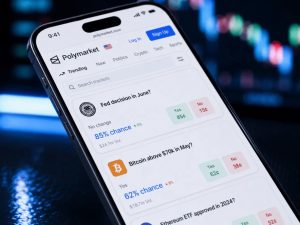
Polymarket operates in roughly 160 countries and is blocked in more than 34 — up from 27 just six months ago. The list keeps growing, and it grows fastest right after high-volume political events. If you are asking whether Polymarket is legal where you live, the honest answer is: it depends on your country, and in the US, on your state.
Is Polymarket Legal in the United States?
The US case is the most confusing one, because the rules changed twice in four years. Polymarket restricted US access in 2022 after a CFTC settlement. In November 2025, the CFTC approved Polymarket’s US entity, and the platform returned to American users in December 2025 — but only through an invite system, with mandatory KYC identity verification for every account.
Federal approval did not end the fight. Nevada’s gaming regulator filed suit against Polymarket over unlicensed sports-adjacent markets. Tennessee issued a cease-and-desist order. The result is a real paradox: Polymarket is legal at the federal level but contested state by state. A federal green light does not guarantee you can use it from every US address. The next real catalyst here is the CLARITY Act working through the Senate — see our full breakdown of is Polymarket legal in the US and the bill’s timeline.
Where Polymarket Is Blocked in Europe
Polymarket geo-blocks users in France, Germany, Italy, the United Kingdom, and the Netherlands as of 2026. The reasoning is consistent across regulators: most European gambling authorities classify prediction markets as a form of wagering. Without a local gambling license, offering these markets to residents is automatically illegal, regardless of the blockchain infrastructure underneath.
Full Blocks Under US Sanctions
Separate from regulatory gambling law, Polymarket enforces a hard block tied to US sanctions (OFAC) in Russia, Iran, North Korea, Cuba, and Syria. There is no partial access and no workaround built into the platform for these jurisdictions — the block exists at the compliance layer, not the licensing layer, and Polymarket has no discretion to lift it market by market.
Russia is a case worth separating into two layers. The OFAC-driven platform block is absolute — Polymarket itself will not serve Russian IPs, full stop. Domestic Russian law is a different, murkier question: betting on sports and esports is legally permitted, but betting on political events and elections is explicitly excluded by law. That leaves an individual Polymarket user in Russia in a genuine grey zone under domestic law, even setting the platform-side block aside.
Why the Blocklist Keeps Growing
The clearest recent example is Portugal. During the country’s 2026 presidential election, traders routed roughly $120 million through Polymarket in a single week. Within 48 hours, Portuguese regulators blocked the platform outright. Hungary blocked access the same day, without waiting for its own election cycle to force the issue. High-volume political events now function as a trigger — the bigger the number, the faster a regulator moves.
Who Actually Uses Polymarket
Similarweb traffic data shows where the real user base sits, independent of where access is technically blocked:
| Country | Share of accounts |
|---|---|
| United States | 24% |
| Canada | 2nd largest |
| United Kingdom | 3rd largest |
| Germany | 4th largest |
| Hong Kong | 5th largest |
Notice that the UK and Germany both appear on the blocked list above and in the top-5 user list here. Geo-blocks reduce direct website access; they do not eliminate demand.
How People in Blocked Countries Still Trade
Polymarket’s geo-block reads the IP address of your browser. That is the entire mechanism — no browser IP match to a restricted region, no access to the interface. For the technical detail of how this IP check works and the full current blocklist, see our geo-blocking breakdown. Telegram-based trading bots sidestep this by connecting directly to Polymarket’s smart contracts on Polygon rather than routing through the website at all. Your browser’s IP never enters the transaction.
Overdog is one tool built this way. It is non-custodial — you hold your own keys and can export your wallet at any time — and it accepts deposits from multiple networks (EVM chains, Tron, Solana, BTC). Because it runs its own node on Polygon, trade execution avoids the extra latency that VPN-based workarounds add, which matters on markets that move fast around news events. It also has its own referral structure for anyone using it regularly. If your country is on the blocked list and you understand the legal grey areas involved, this is the access route worth understanding before reaching for a VPN.
FAQ: Polymarket Legal Status
Is Polymarket legal in the US right now? Yes, federally, since the CFTC approval in November 2025 and the platform’s December 2025 relaunch — but access is invite-only with mandatory KYC, and some states are actively contesting it.
Is Polymarket legal in the UK? No. The UK is on Polymarket’s blocked list as of 2026, in line with how UK gambling regulation treats prediction markets.
Can I get in legal trouble for using Polymarket from a blocked country? Rules differ by jurisdiction. Read our full Polymarket guide and verify your specific local law — this article is not legal advice.
Does a VPN make Polymarket legal to use from a blocked country? No. A VPN can change what IP address the platform sees, but it does not change the underlying legal status in your actual location.
This article is general information, not legal advice. See our Disclaimer for full terms.