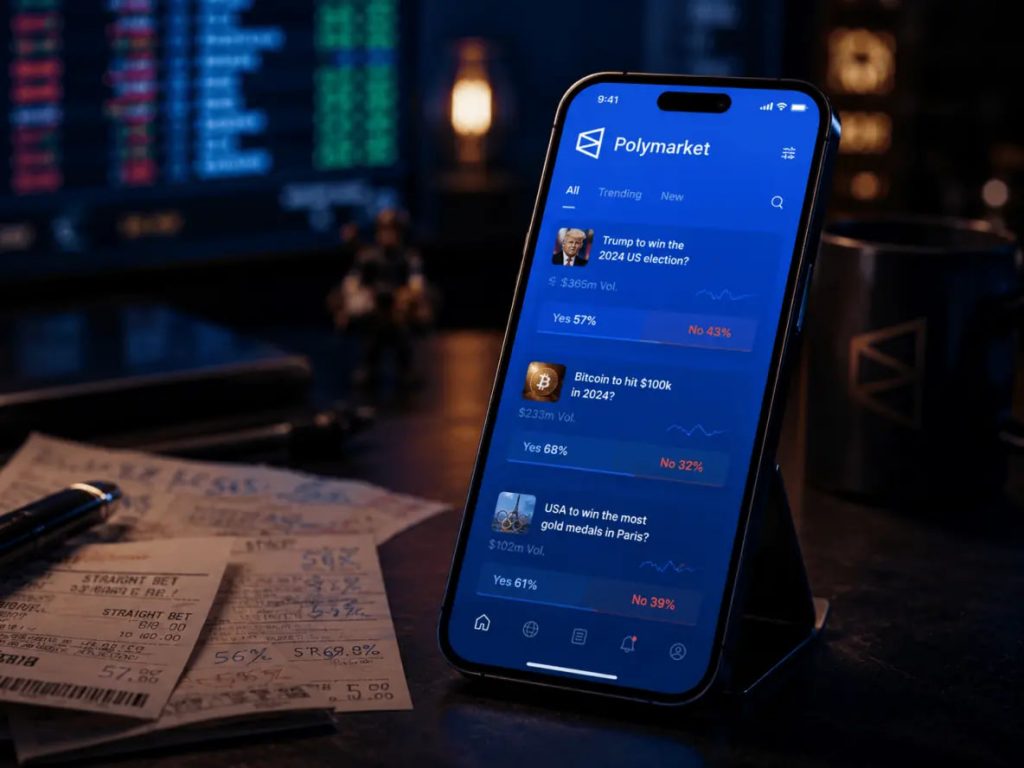
This overdog review looks at what happens after the no-KYC headline: how deposits, withdrawals, fees, and order routing actually work on a platform that bills itself as an access layer to Polymarket’s exchange rather than a sportsbook of its own. The pitch is simple — skip identity verification, keep self-custody of funds, and trade the same prices that show up on Polymarket itself. Whether that trade-off is worth it depends on details that rarely survive a quick glance at the landing page.
What Overdog Actually Is
Overdog is not a separate exchange with its own order book. It routes orders onto Polymarket’s exchange under its own verified builder code, which means every market shown on the site is a real Polymarket market with the same underlying liquidity. The practical effect is that prices move with Polymarket’s order book, not with a bookmaker setting a line. There is no house edge baked into the displayed odds — Overdog isn’t pricing risk against its own balance sheet, it’s passing orders through to an exchange that already has its own buyers and sellers on both sides of every trade.
That distinction matters for anyone used to a traditional sportsbook, where the house sets the line and can move it independently of what bettors actually think. On Overdog, as on Polymarket directly, the price is whatever the last matched trade says it is. A builder code, in this context, works as an attribution layer: it tells Polymarket’s exchange which front end originated an order without changing how that order is matched or settled on-chain.
This puts Overdog in the same category as the execution tools we covered in our roundup of Polymarket trading terminals for blocked countries: a front end that sits on top of Polymarket’s liquidity rather than competing with it.
The No-KYC Deposit and Withdrawal Flow
Opening an account does not involve a passport upload, a utility bill, or a selfie verification step. The account itself is a crypto wallet — signing in creates a wallet-backed account rather than a verified identity, which is a different approach from the proxy wallet Polymarket generates for each user, something we break down in our proxy wallet explainer.
Deposits go in as ETH on one of four networks: Ethereum, Arbitrum, Base, or Optimism. That ETH is converted into Polymarket’s dollar-pegged settlement unit, held one-to-one against the dollar, before it touches any market. Which network a trader picks mostly comes down to gas costs and whichever chain already holds their funds — Ethereum mainnet deposits will carry higher network fees than an Arbitrum, Base, or Optimism deposit of the same size, so the network choice is really a cost decision made before the trading fees described below even enter the picture.
Withdrawals come back out in stablecoins — USDC on Polygon or Solana, or USDT on Tron. The wallet itself is exportable, so funds are not locked to the interface at any point; a trader can pull their private key and move the same balance into another wallet or interface entirely. That also means the usual self-custody trade-off applies: there is no customer support desk that can reset a lost key or reverse a mistaken transfer, since Overdog never takes custody of the funds in the first place. For comparison against Polymarket’s own funding paths, see our guide on how to deposit on Polymarket.
The “no KYC” label here is operational, not a claim of anonymity. Overdog states openly that it makes no claim to be licensed, regulated, or approved in any jurisdiction, and the absence of an identity check should be read as a product design choice rather than a legal guarantee of any kind.
Fee Structure
Overdog charges a flat 1% fee on bets, and Polymarket’s own taker fee applies on top of that. Both are stated in the open rather than folded invisibly into the displayed odds. The combined cost scales with how lopsided the price is:
- A heavy favorite priced at 90¢ carries a 1.5% total fee
- A coin-flip bet at 50¢ carries a 3.5% total fee
- A longshot at 20¢ carries a 5.0% total fee
Longshots costing more in total fees than favorites is a direct function of Polymarket’s own fee curve, which taxes low-probability outcomes more heavily in percentage terms. The underlying logic is that a dollar risked on a 20¢ contract has to move much further, percentage-wise, to realize its payout than a dollar risked on a 90¢ contract, so the fee is scaled to the size of the probability swing rather than charged as a flat percentage of stake regardless of price. For a trader placing a handful of bets this difference is marginal; for a trader running frequent, smaller-edge positions on longshot markets, the gap between a 1.5% and a 5.0% total fee can quietly erode an edge that looked fine on paper. Anyone comparing displayed odds across platforms should check whether the fee is already priced in or added separately, which is the same spread question we cover in our bid-ask spread breakdown.
Markets Covered
Overdog carries standard sports lines — basketball, baseball, tennis, golf, cricket, MMA, American football — priced off the same order book as Polymarket’s own sports markets. It also carries esports markets covering CS2, Dota 2, League of Legends, and Valorant, which settle “exactly like sports markets: same order book, same fee, same on-chain resolution.” That last point is worth sitting with — because settlement happens on-chain against Polymarket’s own resolution sources rather than through an internal grading desk, there’s no separate dispute process specific to Overdog; the outcome a trader sees is the outcome Polymarket’s market has already settled to. Traders already following esports pricing on Polymarket can cross-check line movement against our breakdown of how Polymarket esports odds actually work.
Who This Fits
Overdog is built for traders who already understand Polymarket’s order book and want a wallet-based entry point without an identity verification step. It is not built for anonymity in the legal sense — the platform is explicit that it carries no license or regulatory approval in any jurisdiction, so users remain responsible for checking whether accessing Polymarket’s markets is permitted where they are. It also assumes a baseline comfort with self-custody: holding your own keys means holding your own risk if a device is lost or a seed phrase is mishandled, in exchange for not depending on a third party to hold or release your funds.
The fee structure rewards traders betting on favorites and penalizes longshot bets more than the headline percentage suggests at first glance. Anyone placing size on low-probability outcomes should run the combined fee math before committing, since the gap between a 90¢ favorite and a 20¢ longshot is more than three times the total cost. That math matters more the more often someone trades — a single longshot bet absorbs the extra fee easily, but a strategy built around repeatedly backing longshots will feel the difference over time in a way a strategy built around favorites will not.
For traders weighing Overdog against other entry points, the full field of options — including copy trading and analytics tools — is covered in our terminal comparison, and the mechanics of exporting and controlling the underlying wallet are worth reading in our proxy wallet guide before moving real funds through either path.